If you're starting a business, there's a good chance you've asked one of these questions:
- How much does a business website cost?
- How much does a business app cost?
- Do I need both?
And if you've spoken to a few development agencies, you've probably noticed something frustrating: the answer is often "it depends."
That's technically true, but it's not particularly useful.
The reality is that the cost of a website or app depends on a relatively small number of factors. Once you understand those factors, it becomes much easier to estimate a realistic budget, compare proposals, and avoid paying for features your business doesn't need yet.
This guide breaks down what actually affects website and app development costs, how websites and apps serve different purposes, and how startups can build both without unnecessarily increasing their development budget.
What Drives Business Website Cost?
A business website can cost a few thousand dollars or significantly more depending on what you're asking it to do.
The biggest mistake is thinking of a website as simply "a few pages." A modern business website can be anything from a straightforward marketing site to a full customer-facing platform with payments, bookings, accounts, integrations, and custom functionality.
Here are the main factors that determine the cost.
1. Number of Pages
A five-page business website is naturally different from a 30-page website.
A basic site might include:
- Home
- About
- Services
- Contact
- FAQ
That is relatively straightforward.
A larger site might need individual pages for every service, location, team member, case study, product, resource, or customer segment.
More pages don't automatically mean dramatically higher costs, especially if they use reusable templates. But pages that require unique layouts, interactions, or functionality take considerably more design and development time.
2. Custom Design
There is a significant difference between putting content into a pre-built template and designing a website around a company's specific brand and customers.
A template-based site can be perfectly appropriate for a small business with a limited budget.
A custom-designed website becomes more valuable when your business needs to differentiate itself, communicate a particular brand, or create a more specialized customer experience.
The cost is influenced not just by how the homepage looks, but by how many unique page layouts, components, animations, responsive states, and interactions need to be designed.
3. E-Commerce
Selling products online introduces another layer of complexity.
An e-commerce website may need:
- Product catalogs
- Product variations
- Shopping carts
- Checkout
- Online payments
- Customer accounts
- Order management
- Inventory management
- Shipping calculations
- Discount codes
- Tax handling
- Transaction emails
A small product catalog with a standard checkout is relatively manageable.
A marketplace, subscription business, or store with complex product and fulfillment requirements is a much larger project.
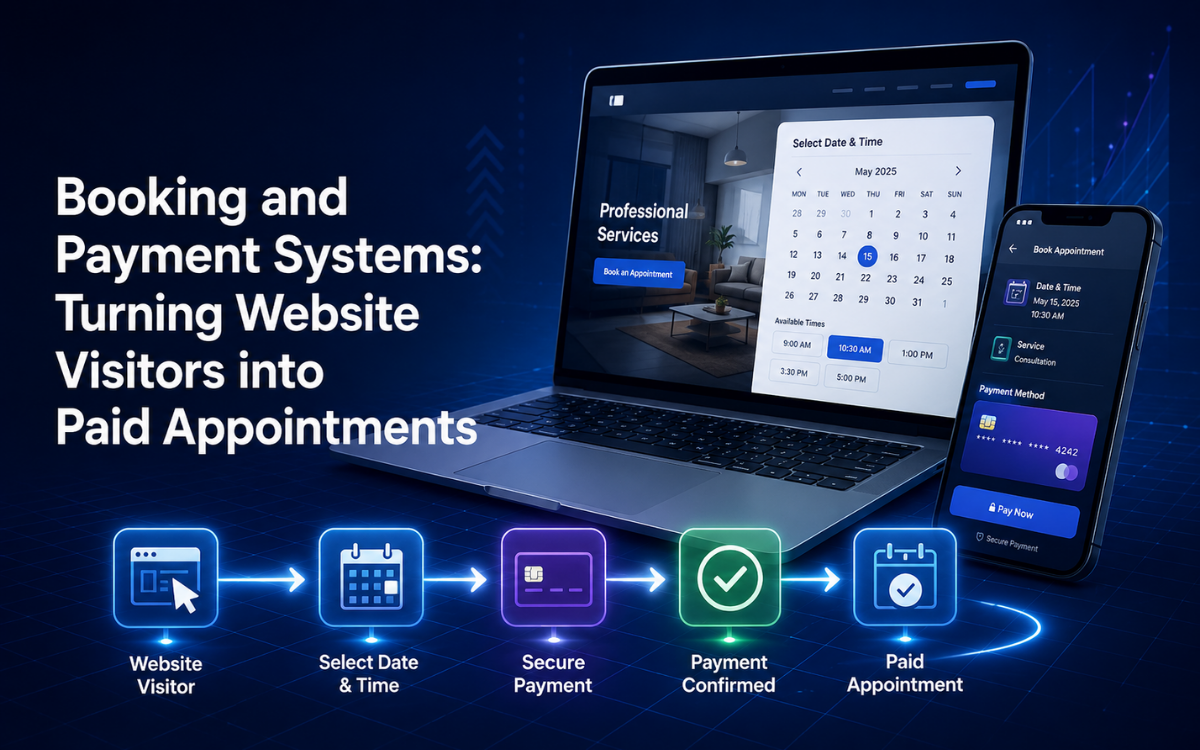
4. Booking and Payments
Service businesses often need more than a contact form.
A salon, clinic, consultant, fitness studio, tutor, or professional service provider might need customers to:
- Choose a service
- Select a staff member
- View available times
- Book an appointment
- Pay online
- Receive confirmation
- Get reminders
- Reschedule or cancel
That functionality requires considerably more development than a brochure-style website.
However, it can also have a direct impact on revenue by turning website visitors into paying customers without requiring someone on your team to manually handle every appointment.
5. Customer Accounts and Portals
Some businesses need customers to log in and access personalized information.
For example, a website might provide:
- Order history
- Appointments
- Invoices
- Documents
- Saved preferences
- Membership information
- Subscription details
- Private resources
Once users have accounts, the website becomes less like a marketing site and more like a software application.
6. Content
Development isn't the only cost involved in launching a website.
You also need to consider whether you already have:
- Website copy
- Product descriptions
- Professional photography
- Videos
- Illustrations
- Brand assets
- Case studies
- Testimonials
If these need to be created from scratch, the project will require additional time and budget.
This is one reason two websites with an identical number of pages can have very different project costs.
What Does a Business Website Typically Cost?
There isn't one universal price, but a useful way to think about website budgets is by complexity.
Basic Business Website
A simple business website might include several professionally designed pages, responsive development, contact forms, basic SEO setup, and a content management system.
This is usually appropriate for businesses whose primary goal is to establish an online presence and generate inquiries.
Custom Business Website
A more sophisticated site may include custom UX/UI design, multiple page templates, integrations, advanced forms, booking, content management, analytics, and more extensive SEO considerations.
This is appropriate when the website plays a significant role in customer acquisition.
Website With E-Commerce, Booking, or Custom Integrations
Once the website handles transactions, appointments, customer accounts, or connections to other business software, development costs increase.
At this point, you're not simply buying "a website."
You're building a business system that happens to run in a browser.
That's an important distinction when comparing quotes.
What Drives Business App Cost?
The question "How much does a business app cost?" is even harder to answer because an app can mean many different things.
A simple customer app and a complex multi-sided marketplace are both technically "business apps," but they're completely different development projects.
The biggest cost drivers are platform, features, user roles, and integrations.
1. iOS, Android, or Both?
Building for one platform can be less expensive than maintaining separate native applications for both iOS and Android.
Cross-platform development can also allow a business to reach multiple platforms while sharing a substantial portion of the codebase.
The right approach depends on the product, required performance, device-specific functionality, and long-term plans.
The important point is to decide based on business requirements rather than automatically assuming you need separate applications from day one.
2. Number of Features
Every additional feature introduces design, development, testing, and maintenance requirements.
A first version of an app might only need:
- Account creation
- User profiles
- Service browsing
- Booking
- Payments
- Notifications
A later version might add:
- Loyalty programs
- Messaging
- Reviews
- Advanced analytics
- Referral systems
- Multiple subscription levels
- AI features
- Complex reporting
Trying to build all of these features before launching can significantly increase the initial cost.
3. User Roles
An app for one type of user is generally simpler than an application serving several different groups.
For example, a booking platform might have:
- Customers
- Staff
- Managers
- Administrators
Each role may have different screens, permissions, workflows, and data.
A marketplace could add even more complexity by introducing buyers, sellers, delivery partners, and administrators.
User roles are therefore an important part of any app cost estimate.
4. Integrations
Integrations are another major factor.
Your app may need to connect with:
- Payment providers
- Calendars
- Accounting software
- CRM systems
- Email platforms
- SMS services
- Inventory systems
- Maps
- Existing databases
- Internal business software
The more systems an app needs to communicate with, the more technical work is involved.
The quality and limitations of those third-party APIs also matter.
How Much Does a Business App Typically Cost?
Again, there is no single universal number.
A focused app with a small number of core features can be relatively affordable, particularly when it uses an efficient architecture and avoids unnecessary complexity.
A larger custom application with multiple user roles, payments, real-time functionality, integrations, and administrative tools can require a significantly larger investment.
The most effective way to control the cost isn't necessarily finding the cheapest developer.
It's controlling the scope.
Start With an MVP
An MVP, or minimum viable product, is the smallest version of the product that can solve the core customer problem.
For example, imagine you're building an app for a fitness studio.
You might eventually want:
- Class booking
- Payments
- Memberships
- Push notifications
- Trainer profiles
- Messaging
- Workout tracking
- Loyalty rewards
- Referral programs
But the first version might only need:
Account → Classes → Booking → Payment → Confirmation
That's enough to test whether customers actually use the product.
If they do, you can build the next set of features using real customer feedback rather than assumptions.
This is one of the most practical ways to achieve affordable business app development without building a low-quality product.
Website vs. App: Which Does Your Business Need?
The difference between a website and an app isn't simply technical.
They serve different jobs.
A Website Is Primarily for Discovery
A website is usually where potential customers first encounter your business.
They can:
- Find you through Google
- Learn about your services
- Compare your offering
- Read reviews and testimonials
- View your portfolio
- Check pricing
- Contact you
- Book an appointment
- Make a purchase
There's no installation process.
A customer clicks a link and immediately has access.
That's why a website is often the better first investment for a startup or small business.
An App Is Primarily for Retention
An app becomes more valuable when customers already have a reason to return frequently.
For example:
- A gym member checking classes
- A restaurant customer placing repeat orders
- A marketplace buyer tracking purchases
- A patient managing appointments
- A subscription customer accessing their account
- A delivery customer tracking an order
An app can provide a faster, more personalized experience for repeat users.
But convincing someone to download an app before they have a reason to use your business repeatedly is difficult.
That's why many businesses benefit from building the website first.
Website or App First? A Simple Rule
For most startups and small businesses:
Build the website first if you're still acquiring customers.
Build an app when you have enough repeat customers to justify one.
There are exceptions.
An app may make sense from the beginning if the business itself depends on an app-based experience.
Examples include:
- Marketplaces
- On-demand services
- Delivery platforms
- Social products
- Mobile-first services
- Products requiring frequent mobile interaction
- Businesses where customers need persistent access to an account
But if you're a local service business trying to get discovered and generate leads, a high-quality website will usually provide more immediate value than a mobile app.
Why the Cheapest Website or App Can Become the Most Expensive
Imagine you spend less upfront by choosing a quick solution that isn't designed around your actual business requirements.
Six months later, you discover that:
- The design doesn't convert visitors
- The code is difficult to maintain
- The booking system doesn't work the way your team needs
- Adding payments requires rebuilding the system
- The developer owns the source code
- Your data is difficult to export
- New features require expensive workarounds
You haven't actually saved money.
You've postponed the cost.
This doesn't mean startups should spend excessively on version one.
It means the initial architecture should be good enough to support sensible future growth.
How to Get a Website and App Without Overpaying
The goal shouldn't be to find the lowest possible development price.
The goal should be to get the right amount of development for your current stage of business.
A strong development partner should be able to explain:
What You Need Now
- Which features are essential to launch?
- Which ones directly support your business model?
- Which features can wait?
What You Can Add Later
A good development plan should identify future functionality without forcing you to pay for all of it upfront.
For example:
- Phase 1: Website + lead generation
- Phase 2: Online booking + payments
- Phase 3: Customer accounts
- Phase 4: Mobile app
What You Own
Before development begins, clarify ownership of:
- Source code
- Website
- App
- Database
- Customer data
- Domain
- Design files
- Accounts
- Third-party services
What Future Changes Will Cost
Ask your developer:
"If we want to add this feature six months from now, what would need to change?"
A good development partner should be able to explain whether the current architecture leaves room for expansion.
The Best Approach for Startups: Build in Stages
Startups rarely have unlimited budgets.
At the same time, building something too cheaply can create technical debt that becomes expensive later.
The middle ground is staged development.
Stage 1: Build the Foundation
Launch a professional website that clearly explains the business and gives customers a way to contact, book, or buy.
Stage 2: Improve Conversion
Add functionality based on actual customer behavior:
- Booking
- Payments
- Customer accounts
- Automated emails
- CRM integrations
Stage 3: Build Customer Retention
Once there's a meaningful base of repeat customers, consider an app.
Stage 4: Expand the Product
Use customer feedback and business data to decide what comes next.
This could include:
- Loyalty features
- Subscriptions
- Messaging
- Advanced analytics
- Personalization
- Automation
- Additional integrations
Questions to Ask Before Hiring a Development Company
Before agreeing to a website or app project, ask these questions:
1. What's Included in the Quoted Price?
Get a clear list of deliverables rather than relying on a general description.
2. What Isn't Included?
This can be just as important.
3. Who Owns the Source Code?
Make sure ownership is clearly documented.
4. Who Owns the Customer Data?
Your customer information should not be trapped inside someone else's system.
5. What Happens When We Need New Features?
Understand the development process and expected costs.
6. Is the Platform Scalable?
You don't need to over-engineer version one, but you should understand its limitations.
7. What Happens After Launch?
Ask about maintenance, bug fixes, hosting, updates, and support.
8. Can We Launch a Smaller First Version?
A good agency should be comfortable discussing what can be removed from the initial scope.
So, How Much Should You Budget?
The honest answer is that there is no single "business website price" or "business app price."
A basic website can be relatively inexpensive.
A custom website with e-commerce, booking, payments, accounts, and integrations will cost more.
A focused business app can be built without an enormous budget when the scope is controlled.
A complex app with multiple platforms, user roles, payments, integrations, and custom workflows requires a much larger investment.
Instead of asking only:
"How much does a website cost?"
Ask:
"What is the smallest version of the website that can achieve our business goal?"
And instead of:
"How much does an app cost?"
Ask:
"What is the smallest app we can launch that customers will actually use?"
Those questions lead to much better development decisions.
Final Takeaway
For most startups and small businesses, the smartest approach isn't to choose between "cheap" and "expensive."
It's to choose between focused and unfocused development.
A focused project builds what the business genuinely needs today while leaving a sensible path for tomorrow.
In many cases, that means starting with a strong website, adding booking or payments when they directly improve the customer journey, and introducing a mobile app once there is a real reason for customers to return frequently.
Affordable business website and app development is absolutely possible—but affordability comes from good scope management, sensible technology choices, and building in stages. It doesn't have to mean cutting corners on quality.
That's the approach SpeckPro takes.
Before development begins, SpeckPro helps businesses define what they actually need, separate essential features from future ideas, and understand what the project is realistically going to cost.
The goal isn't to sell you the biggest website or app possible.
It's to build the right product for the stage your business is at—and give it room to grow.
Frequently Asked Questions
How much does a business website cost?
The cost depends on the website's complexity, design requirements, content, integrations, and functionality. A simple marketing website costs significantly less than a custom platform with e-commerce, booking, payments, and customer accounts.
How much does a business app cost?
Business app costs vary based on platforms, features, user roles, integrations, and overall complexity. An MVP with core functionality is usually much more affordable than a feature-rich enterprise application.
Should a startup build a website or an app first?
For most startups, a website should come first because it helps customers discover the business. Apps typically provide the most value when there is already a base of repeat customers.
Can a website and app share the same backend?
Yes. Many businesses use a shared backend so that websites, mobile apps, customer accounts, payments, bookings, and business data remain synchronized across all platforms.
What is the best way to reduce website and app development costs?
The most effective approach is to launch with an MVP, focus on essential features, build in phases, and avoid adding functionality that customers have not yet proven they need.
SpeckPro Editorial Team
Web DevelopmentNotes from the SpeckPro team on building, improving, and scaling digital products.